

AI agents are intelligent software systems that can autonomously perform tasks, analyze information, and interact with digital systems. Modern agents combine large language models (LLMs), contextual memory, and external tools to automate workflows and support decision-making.
Unlike traditional automation, AI agents can understand natural language, plan multi-step tasks, and adapt to context. AI agents are used in domains that require automation, data processing, and decision support, including:
- Customer support – answering requests and retrieving customer data
- Knowledge assistants – searching internal documents and knowledge bases
- Data analysis – querying databases and generating reports
- Process automation – handling documents, approvals, and workflows
AI Agents Development Services
We help organizations design and deploy production-ready AI agents integrated with business systems and data sources. We provide end-to-end AI agent development services:
- Analysis: Identification of automation opportunities, data sources, and business requirements.
- Architecture & Design: Definition of agent architecture, models, memory systems, and tool integrations.
- Development: Implementation of the AI agent, including LLM integration, retrieval systems, and workflow logic.
- Testing: Validation of agent accuracy, reliability, and performance.
- Integration: Connection with enterprise systems, databases, and APIs.
- Support: Monitoring, optimization, and continuous improvement of the AI system.
AI Agent Architecture
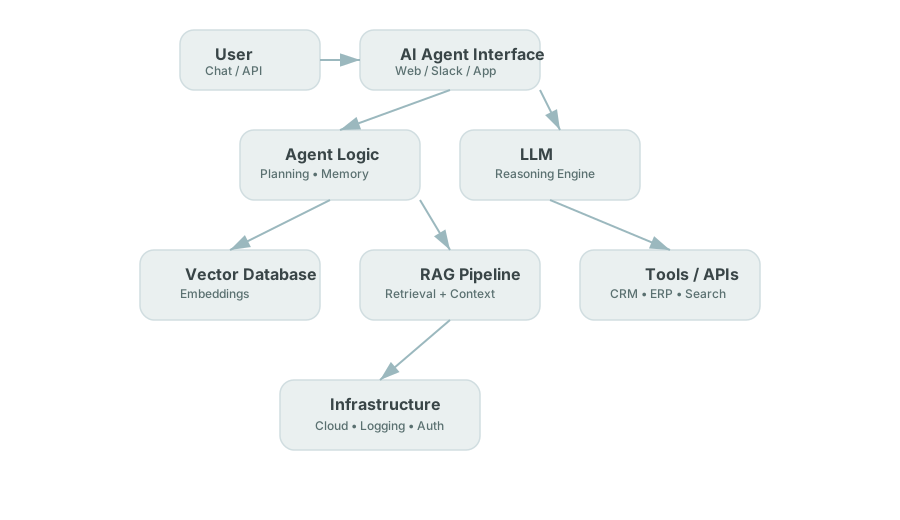
Modern AI agents are typically designed as modular systems composed of several coordinated components that enable reasoning, interaction, and task execution.
Agent (Orchestrator) – the central control layer responsible for managing the overall workflow. It determines the sequence of actions, coordinates communication between internal components, and decides when to invoke tools, access memory, or request additional reasoning from the language model.
Memory / Context – a structured storage layer that maintains conversation history, user context, and retrieved knowledge. This component allows the agent to preserve continuity across interactions and supports retrieval of relevant information to improve accuracy and contextual awareness.
LLM – the reasoning and natural language processing engine of the system. The language model interprets user input, generates responses, plans tasks, and performs higher-level reasoning such as summarization, classification, and structured output generation.
Tools – integrations with external capabilities such as APIs, databases, search services, or internal platforms. These tools extend the agent’s functionality by enabling real-world actions, data retrieval, and interaction with external systems.
Result Layer – the interface responsible for delivering the final output. It formats generated responses, returns structured results, or triggers actions in connected systems, ensuring the output is clear, usable, and aligned with the user’s request.
Retrieval-Augmented Generation (RAG)
Retrieval-Augmented Generation (RAG) is an architecture that enhances an AI agent by connecting it to a trusted knowledge base such as corporate documents, internal wikis, databases, or APIs. Instead of relying only on the language model’s training data, the agent retrieves the most relevant information from your company’s knowledge sources in real time and uses it to generate accurate responses.
For corporate environments, this significantly improves reliability, ensures answers are based on internal documentation, and allows the AI agent to work with constantly updated information. RAG enables powerful use cases such as internal knowledge assistants, customer support automation, onboarding assistants, and technical documentation search across large enterprise knowledge bases.
Why Choose Us
We focus on building reliable AI agents that deliver measurable business value. Our teams have expertise in LLM-based AI systems, scalable and secure architectures, and integration with enterprise software and APIs.
Frequently Asked Questions
AI agents are autonomous or semi-autonomous software systems that use artificial intelligence to perform tasks, make decisions, or assist humans in processes.
A Large Language Model (LLM) is a machine learning model trained on large amounts of text data to understand and generate natural language. LLMs are used in AI agents for tasks such as language understanding, reasoning, planning, summarization, and generating responses."
AI agents reduce manual work, improve operational efficiency, provide actionable insights, enhance customer interactions, and support data-driven decision-making.
A chatbot mainly responds to messages. An AI agent can plan tasks, use tools, and execute workflows.
Yes. We develop AI agents that connect seamlessly with your software ecosystem, internal data sources, and operational processes, helping organizations automate tasks and enhance decision-making without disrupting existing systems.
A simple agent may take a few weeks, while complex enterprise agents may require several months.